

Water Quality
We analyze water quality test results and publish an annual Water Quality Report Card before each beach season.
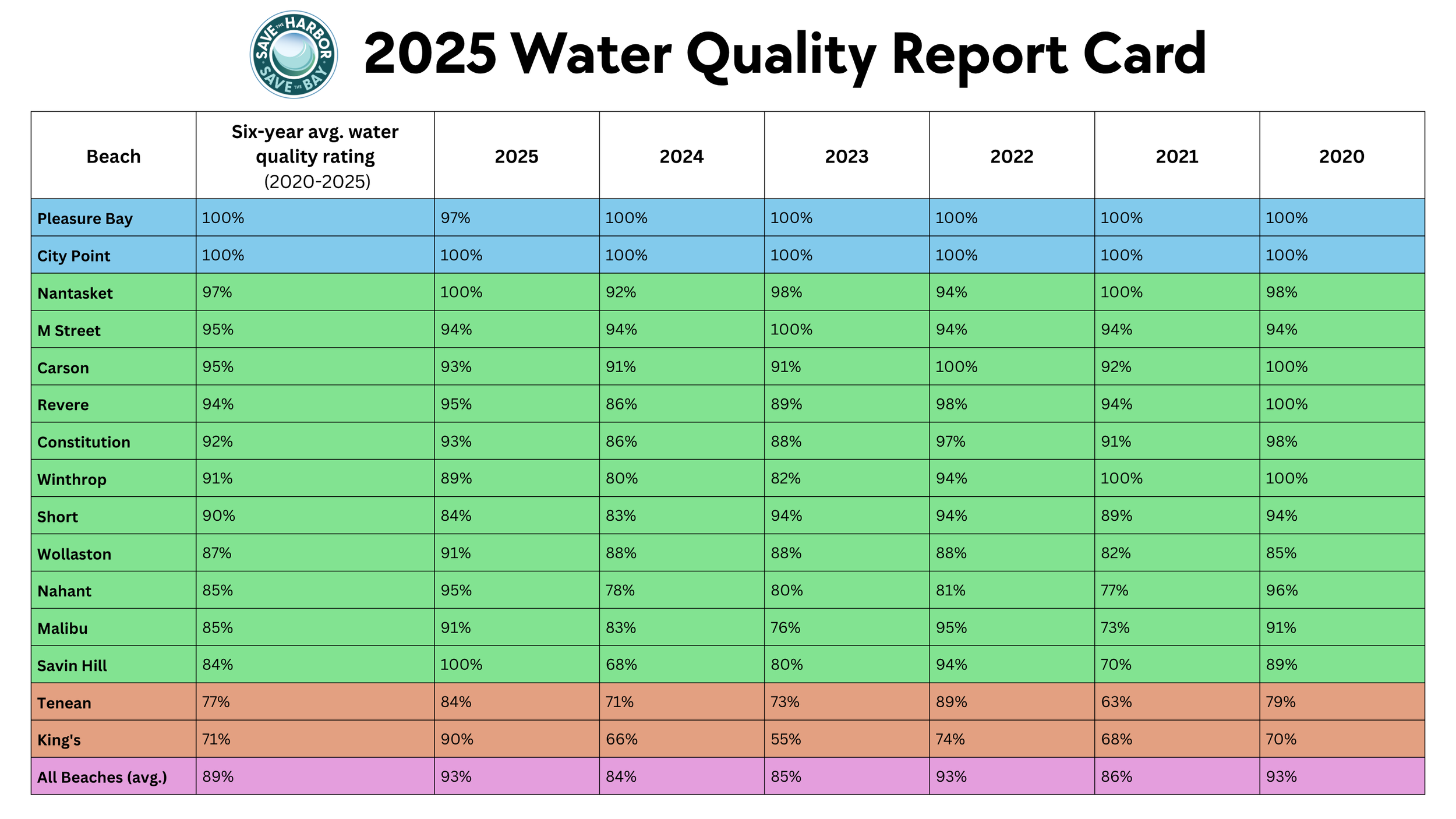
For the first time in its testing history, Save the Harbor/Save the Bay has reported that every metropolitan beach from Nahant to Nantasket scored above 80% in its annual Water Quality Report Card. This is a historic achievement that reflects Save the Harbor’s 40 years of persistent advocacy, public investment in water infrastructure, and rigorous testing. Learn more about this milestone by reading the full press release below!
Frequently Asked Questions
-
We use data from Massachusetts Department of Conservation and Recreation’s (DCR) water quality testing done on the 15 public beaches in the Boston metropolitan region during beach season (May-September).
-
DCR tests the number of colony forming units (CFU’s) of enterococci bacteria. This is the standard unit used to determine safe swimming conditions, according to the US Environmental Protection Agency (EPA). A beach with a high water quality rating means that the beach’s bacteria levels are within safe swimming 80% of the time.
-
Save the Harbor recommends people get familiar with their beach by using the Department of Public Health’s interactive beach water quality dashboard for the most up-to-date data.
We also recommend waiting to swim 24 hours after a heavy rain fall event to avoid sewage overflows and stormwater runoff. -
According to the EPA, enterococci is used to indicate possible contamination by fecal waste. DCR tests for enterococci to see if the water has been contaminated by stormwater runoff, sewage overflows, and domestic animal/wildlife waste.
On their own, enterococci bacteria are not typically the direct cause of illness in swimmers, but their presence in the water is a reliable signal that the water may be contaminated with fecal matter, which can carry pathogens that cause gastrointestinal illness, ear infections, and skin rashes.
When enterococci levels in a water sample exceed a threshold set by the EPA, DCR issues a swim advisory for that beach, and swimmers are advised to stay out of the water.
-
Years ago, Save the Harbor conducted a community survey asking beachgoers how often they felt it was acceptable for a beach to be closed due to water quality reasons. Results showed that people felt that if a beach was unsafe on more than one out of every five days (20% of the time), that was too much. In other words and to standardize the results to our water quality rating, the beach should be swimmable 80% of the time.
The 80% rating threshold was not mandated by a government agency, it came directly from the people who use Boston Harbor's beaches. When Save the Harbor/Save the Bay asked the public how often a beach closure was acceptable, the community gave a clear answer: not more than one day out of five. That answer matters to us. Boston Harbor's beaches are neighborhood resources, and the communities that depend on them deserve a real say in defining what acceptable water quality looks like.
When a beach falls below 80%, we report that the community's own standard is not being met. When it exceeds 80%, we celebrate what this region has accomplished together. Your voice built this standard and your beaches deserve nothing less.
-
Beachgoers should be aware of a notable limitation in how water quality information reaches the public. DCR beaches currently use a posting and flagging system to alert swimmers to unsafe bacteria levels. Posting refers to DPH updating its interactive beach water quality dashboard with enterococci bacteria levels and flagging refers to the DCR closing a beach (red flag) when the tested sample is above safe swimming levels. However, the best water quality testing technology currently available takes 24 hours to return results. This means that by the time a red flag is posted at a beach or DPH issues a swim advisory, the water sample that triggered it was collected the day before. The information is already out of date.
This is not a failure of the testing program; it reflects the limits of the method currently available. But it is something every beachgoer should understand when deciding whether to swim.
Because of this limitation, Save the Harbor/Save the Bay recommends that beachgoers get to know the individual characteristics of their beach rather than relying solely on the daily posting. Some beaches have predictable patterns; water quality tends to decline after heavy rain, for example, or certain wind directions bring cleaner or dirtier water to a particular shoreline. The more familiar you are with your beach, the better equipped you are to make your own informed decision. A good starting point is the Massachusetts Department of Public Health's interactive beach water quality dashboard, which provides historical testing data and beach-specific information that can help you understand what conditions to watch for at your favorite spot.